My Key Learnings from the Project
Initially, my main goal in starting this project was to build a product that solves a real problem and could be launched into the market. During the project, I discovered that Subt addresses key frustration points for small and medium business CEOs, founders, and accounting teams.
However, I also learned that launching a startup isn’t just about solving a problem, it’s about delivering viable business outcomes. After analyzing research data and running multiple validation exercises, I realized that this tool would take over seven years to break even. Many users were looking for free or low-cost solutions, with some still relying on traditional tools like Excel, Google Sheets, and bank statements. A few mentioned that they would consider paying $10–$15 per month, but the overall market willingness to pay was limited.
Despite this, the project provided invaluable learnings about thinking beyond the product itself and focusing on business viability alongside user needs.


How might I solve?
At this stage before diving into ideating, I wanted to talk with a developer to understand how practical is it automate subscriptions management.

Learnings from Developer Interview
Manual entry when API is not available or not used
API integration to auto-track subscriptions
Considered affordable pricing from a business perspective
AI generates temporary invoices (not official)
Temporary invoices shared with accounting automatically
Custom reminders for billing and renewals
Email alerts for all subscription activities
At this point I learned what are practical ways to automation and I was trying to understand solutions in detailed and on how it will used and implemented.

Manual Subscription Tracking
Subscriptions are tracked manually using spreadsheets and excel.
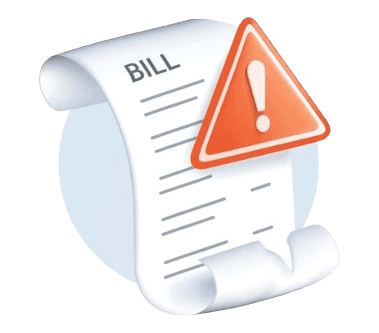
Users get charged unexpectedly due to missed billing and trial end dates.
Unexpected Billing
Invoices are received and sent manually, relying on vendors.
Invoice
"Please feel free to share your thoughts."
Thank you for your time!
rohanpothala21@gmail.com
End-to-End Product Designer
MY ROLE
Self-Initiated Project (3 months)
TIMELINE
FIGMA, Google Forms
TOOLS USED

Designing a subscription management saas tool
Subt is a subscription management tool designed for small medium business, which helps them to automate all their internal subscriptions tracking.
I started with a simple assumption: in a subscriptions-driven world, how do people manage all their subscriptions? As a student, I already had 5–6 subscriptions and struggled to remember and track them. But as I thought deeper, I realized most individuals wouldn’t pay just to manage subscriptions, and they weren’t my target users. Looking at the market, I noticed existing tools focus on large companies, are expensive, and overly complex, with subscription management as just one feature. This led me to a clearer question: how do early-stage startups manage their growing number of subscriptions? That question became the foundation for my user research and this project.
My Experience
Early-stage startups still use Google Sheets, Excel, bank statements, and bookkeeping tools to track subscriptions manually. This creates a lot of repetitive and time-consuming work, like sending invoices to the accounting team every billing cycle and keeping financial records updated.
Because everything is manual, teams often miss renewal dates, free-trial endings, and get charged unexpectedly. Most subscription management tools available today are expensive, complex, and mainly built for large companies, which makes them hard for early-stage startups to use.
The Problem
I began my research by conducting interviews with early-stage startup founders, CEOs, and finance teams to understand their experiences. I started with initial assumptions and turned them into interview questions to better understand user needs and validate those assumptions. and I have done competitive analysis part of my research to understand how do competitor products feels to use.
Problem Discovery

I have Interviewed 11 users
User Interview Key Findings
Key take-aways from competitive analysis.
Competitive Analysis
Complex interfaces with too many tools in a single product
Expensive subscription plans that are not affordable for SMBs
No dedicated products focused on tracking internal subscriptions for small and medium businesses

CEO, SubTrack
Max
Managing subscriptions manually is painful. There’s no clear view of total spending, payment reminders are missed, free trials turn into surprise charges, invoices take too long to collect and share with accounting, and spreadsheets require constant manual updates that still lead to errors.
Problem


Using Excel and Manual Invoice sending
To go deeper and understand problem I have created empathy mapping, affinity mapping to understand what particular themes users have problem with, In this process I have clearly identified and Validated the problems.
Representation of 90% Users.
I went further and created workflow mapping for final validation.
With this process of workflow mapping I learned that users experience is true and the main problem revolving around lot of manual work and Alerts, with this now I clearly know what I need to solve.
Manual Subscription Tracking and No Alerts
Subt is a SaaS subscription management tool that helps small and medium businesses automate their internal subscriptions tracking, eliminating manual work. It’s a simple, automated product focused on three main features, shown below.
Eliminates manual entry by integrating with payment platforms and providing a ready-to-select list of subscriptions.
Automated Subscription Tracking
Sends alerts for upcoming bills, trial endings, and price changes, helping users avoid unexpected charges.
Alerts
Automatically generates invoices and sends them to accounting for documentation.
Auto Invoice
Integrated Stripe and PayPal APIs to automatically track subscription payments.
Customizable alerts are sent through email and dashboard notifications.
AI generates invoices using data from connected payment platforms and automatically sends them to accounting.

Brand Identity
At this stage, the solution was clear, so I focused on creating a visual identity for the product, SUBT. The branding was designed to be simple, and easy to recognize.
Design
Now starting with designing screens, I wanted to see how entire site look like and wanted to understand if user is using this product what all steps do they take and flow through starting from onboarding to using core of the product. I have created card sorting to understand what all list of things are involved in the product.
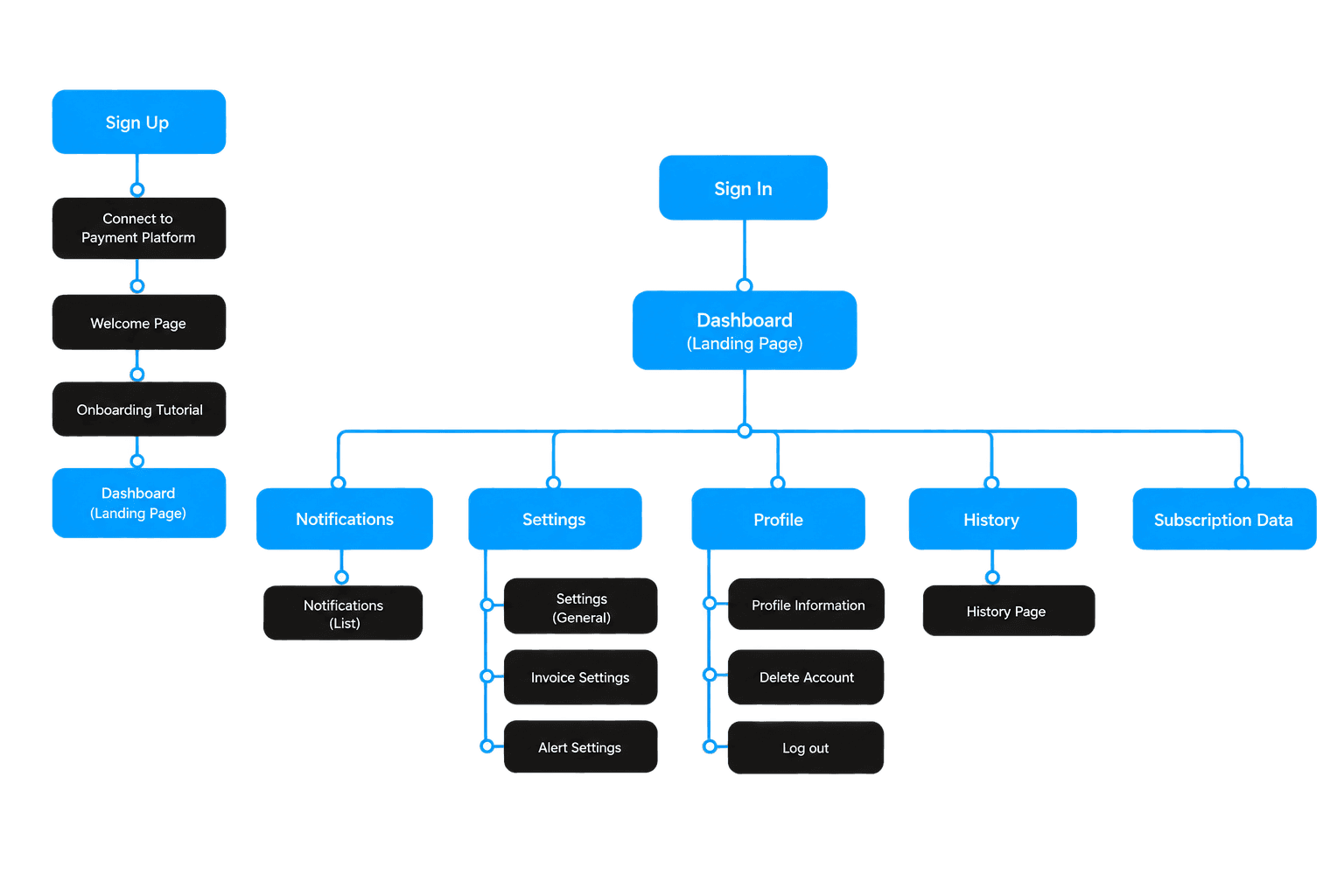


Site Map
Card Sorting
User Flow

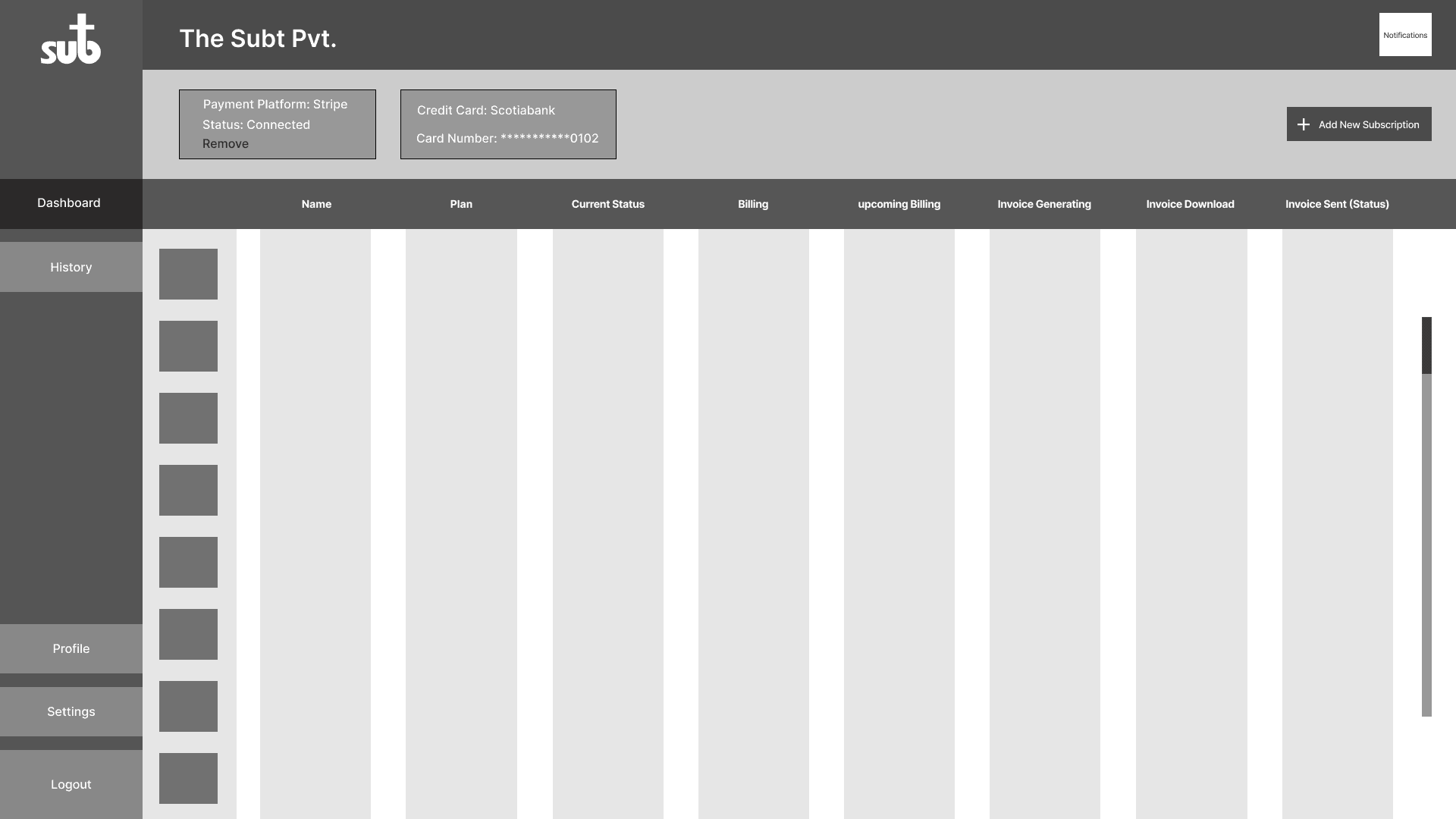
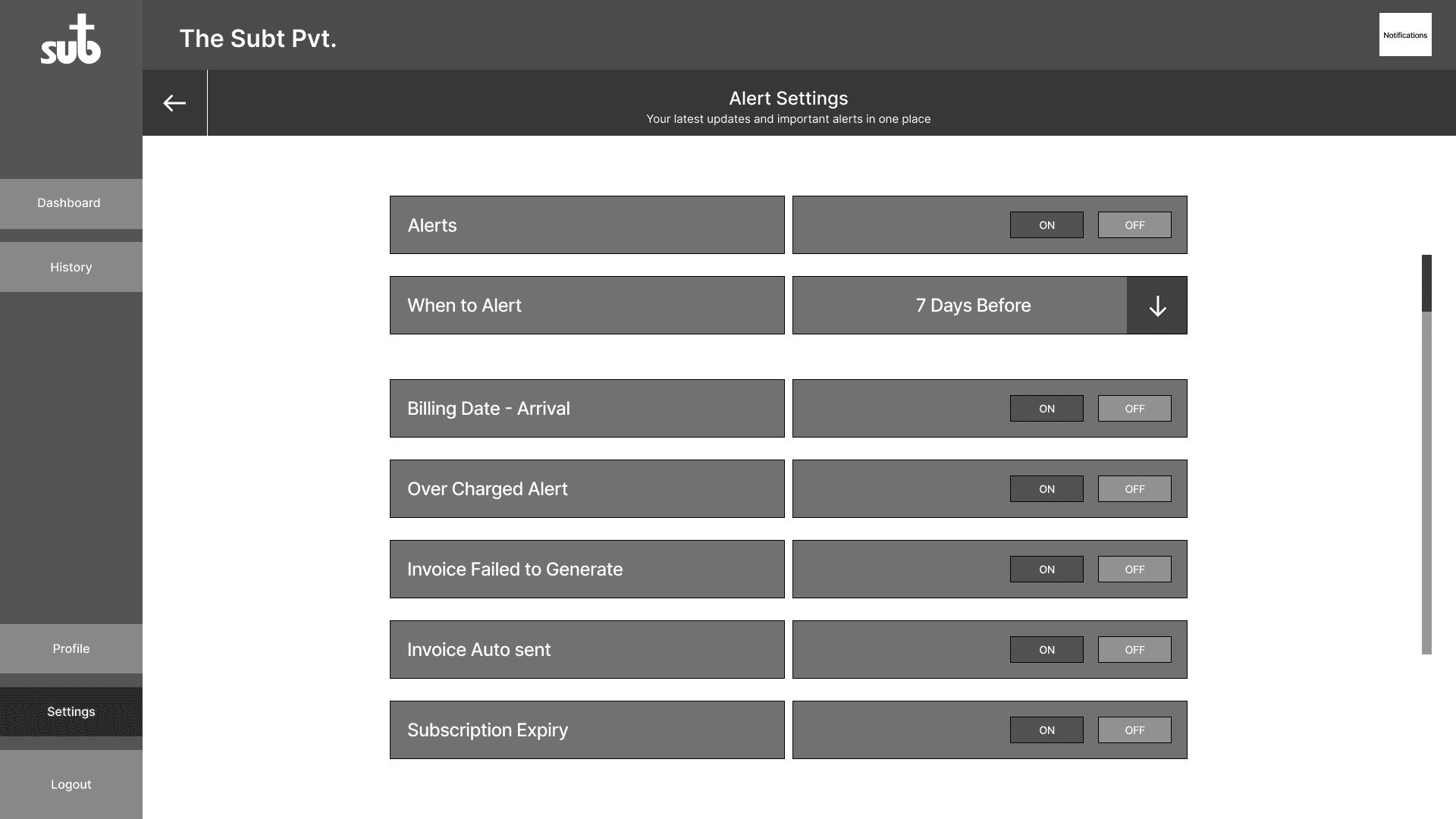


Based on my site map and user flow, I have sketched out to see how the product looks like visually, to design better navigation like where do core features exist? how does dashboard look like?
Once I validated the visuals of concept sketches I went forward to design mid fidelity.

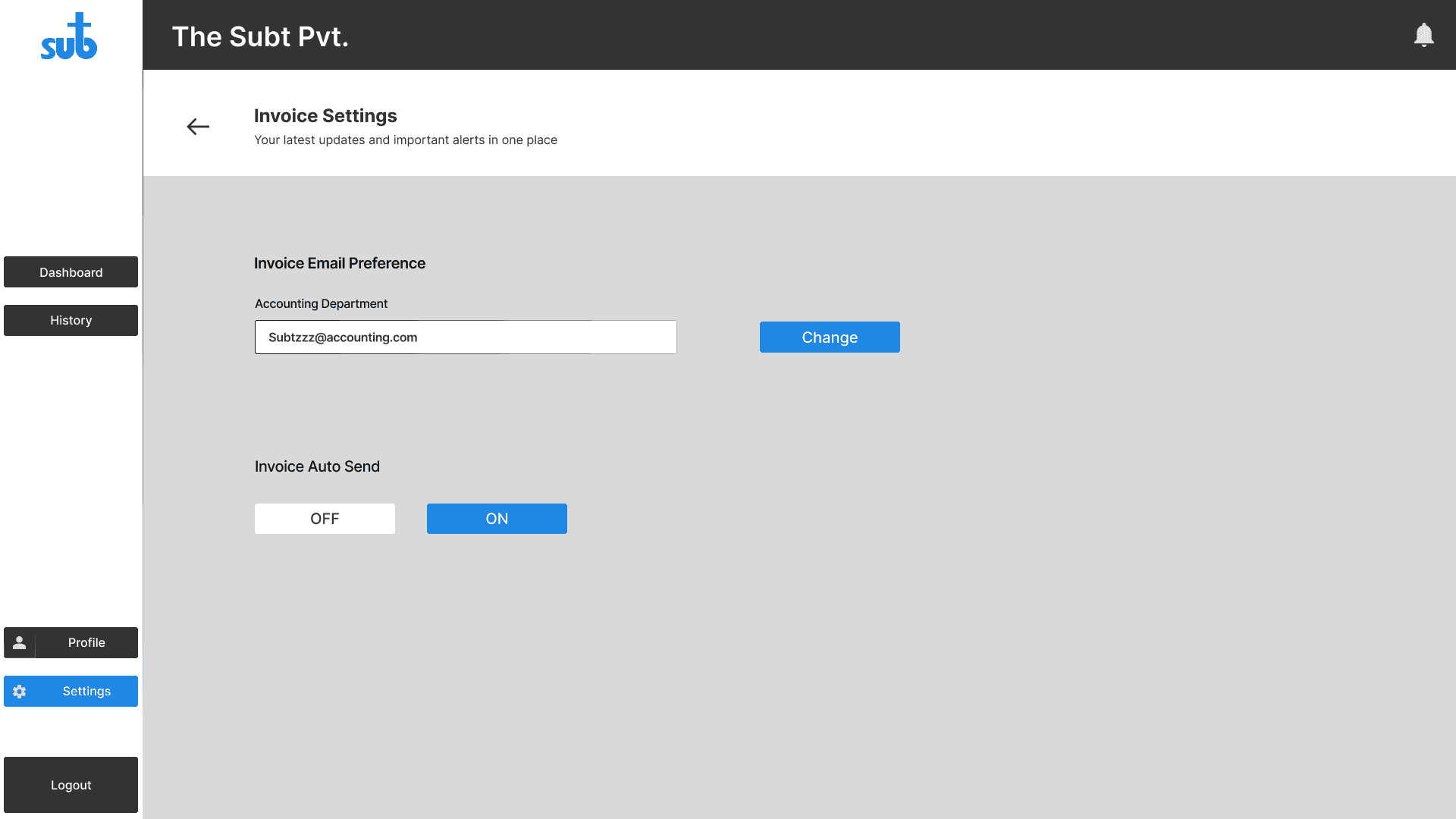
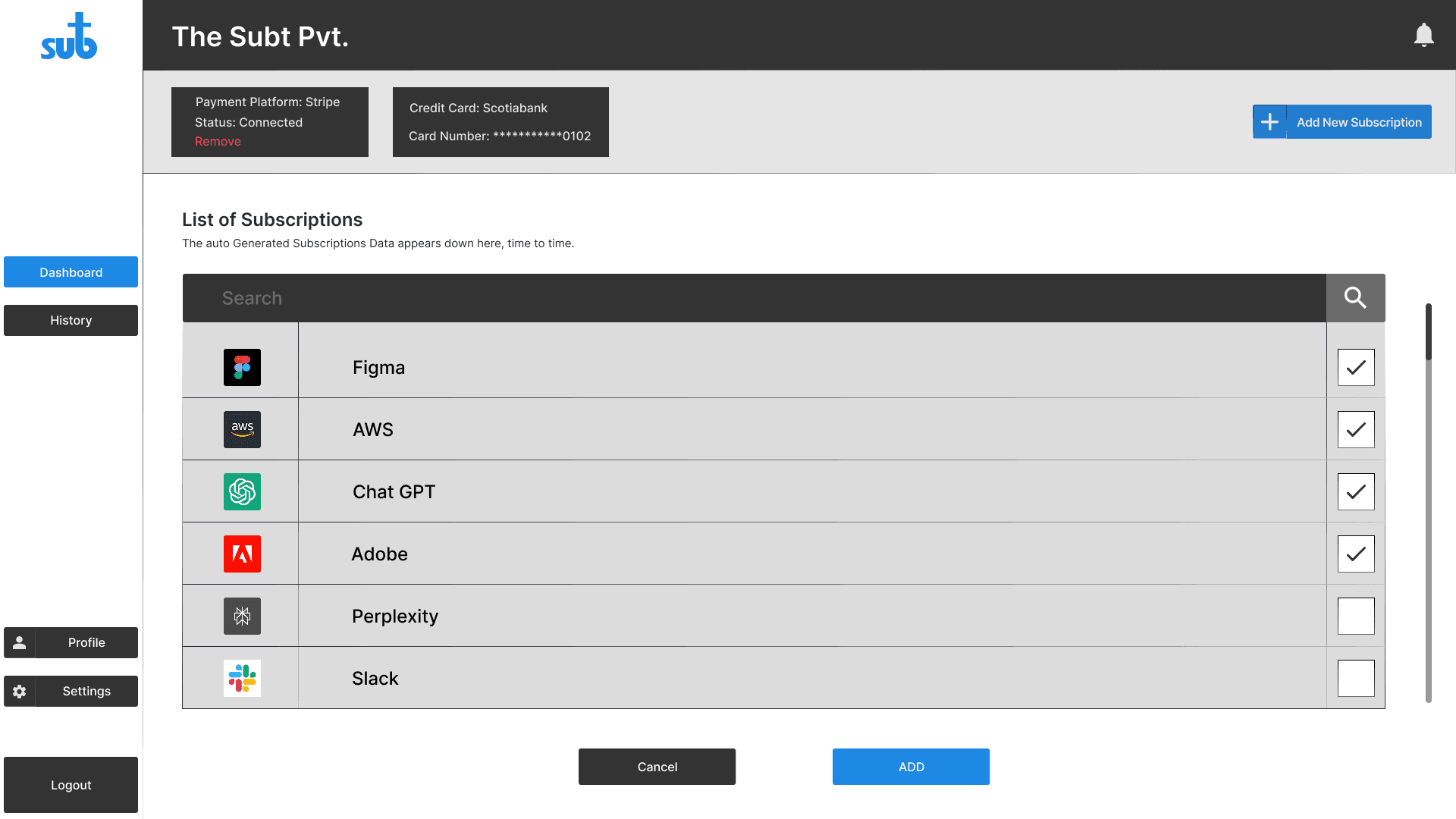


Usability Testing
At this point I have designed V1 with ready to use prototype and I did remote usability testing with target users like CEO's, Founders, Technical department.
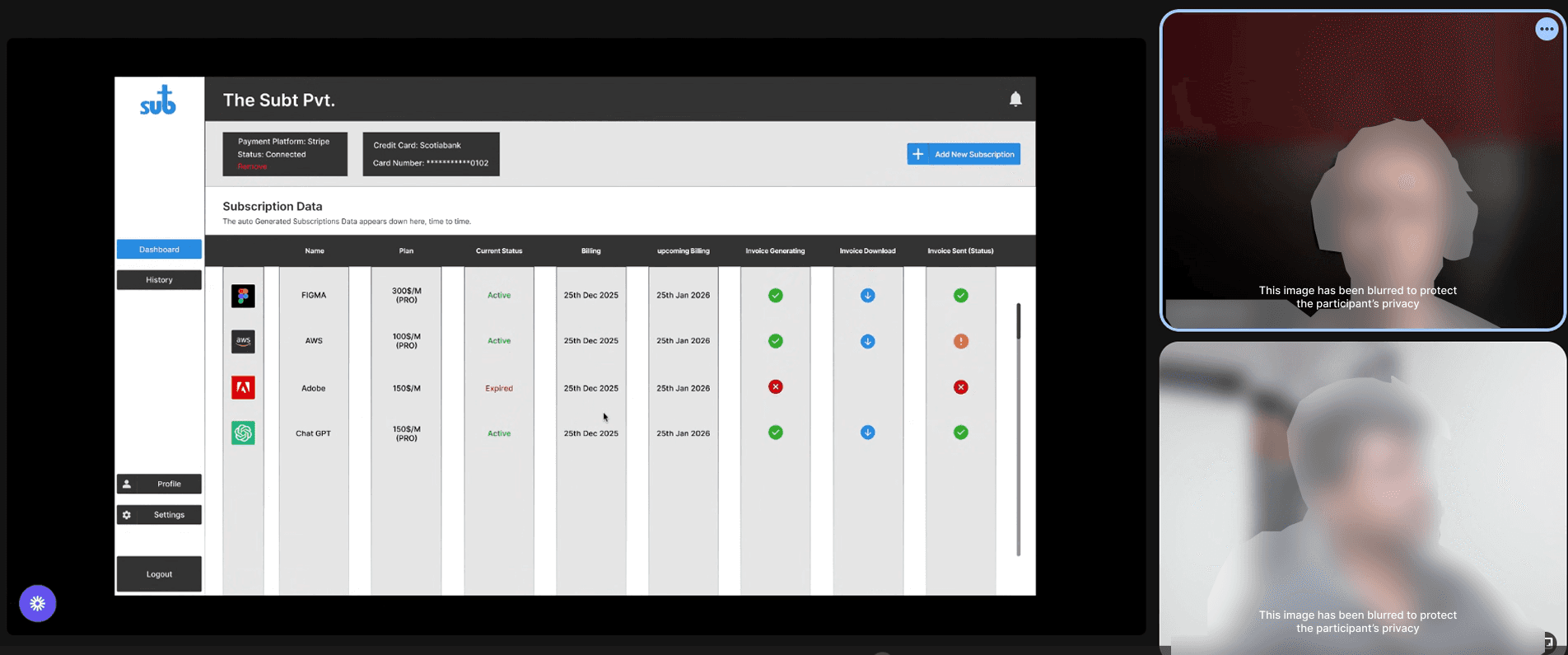

I gathered the data and started analyzing them by breaking them down through affinity mapping, and from this usability testing and affinity mapping I learned that:

Positive Feedback from Usability Testing

90% of users raised concerns about privacy and security, as they need to get trust, Lack of modern UI, some suggested addon features for better experience.
Key Feedback from Usability Testing

From this usability testing I learned that user really found this product helpful and as value proposition but they need to get trust, and they need to feel the product is safe to use.
Solutions for Iteration
Iteration
I designed the product based on user feedback, with a strong focus on building trust and making users feel safe while using it. I improved the overall UI with a clean, modern design and created a landing page that clearly explains the product and its value.I also introduced a demo trial so users can experience how the tool works before committing. Manual subscription handling was removed to make the entire workflow fully automated and seamless. The landing page was structured carefully with user flow and information hierarchy in mind, ensuring users receive the right information at the right time as they scroll.

The goal was to design the hero section so users can quickly understand what the product is about at first glance. I wanted to give an immediate visual preview of the main component, the dashboard, so users can see how the product looks and works.
I also highlighted trusted users to build credibility and create a sense of safety and confidence in using the product.
Landing Page Design

This section was designed to introduce the product, Subt, and highlight its core features. The goal was to help users clearly understand what Subt is and what key features it offers.

This section was designed to communicate that users no longer need to deal with the usual manual challenges of subscription management. It highlights how our tool eliminates these common problems and provides a more streamlined, automated solution.

For Subt, data privacy and security are extremely important and form the foundation of building trust and a safe platform. This section was designed to clearly communicate our commitment to protecting user data.
We highlighted that we use trusted infrastructure providers like AWS to securely store data. Since AWS is widely recognized and trusted, this helps reassure users that their information is handled in a secure and reliable environment.
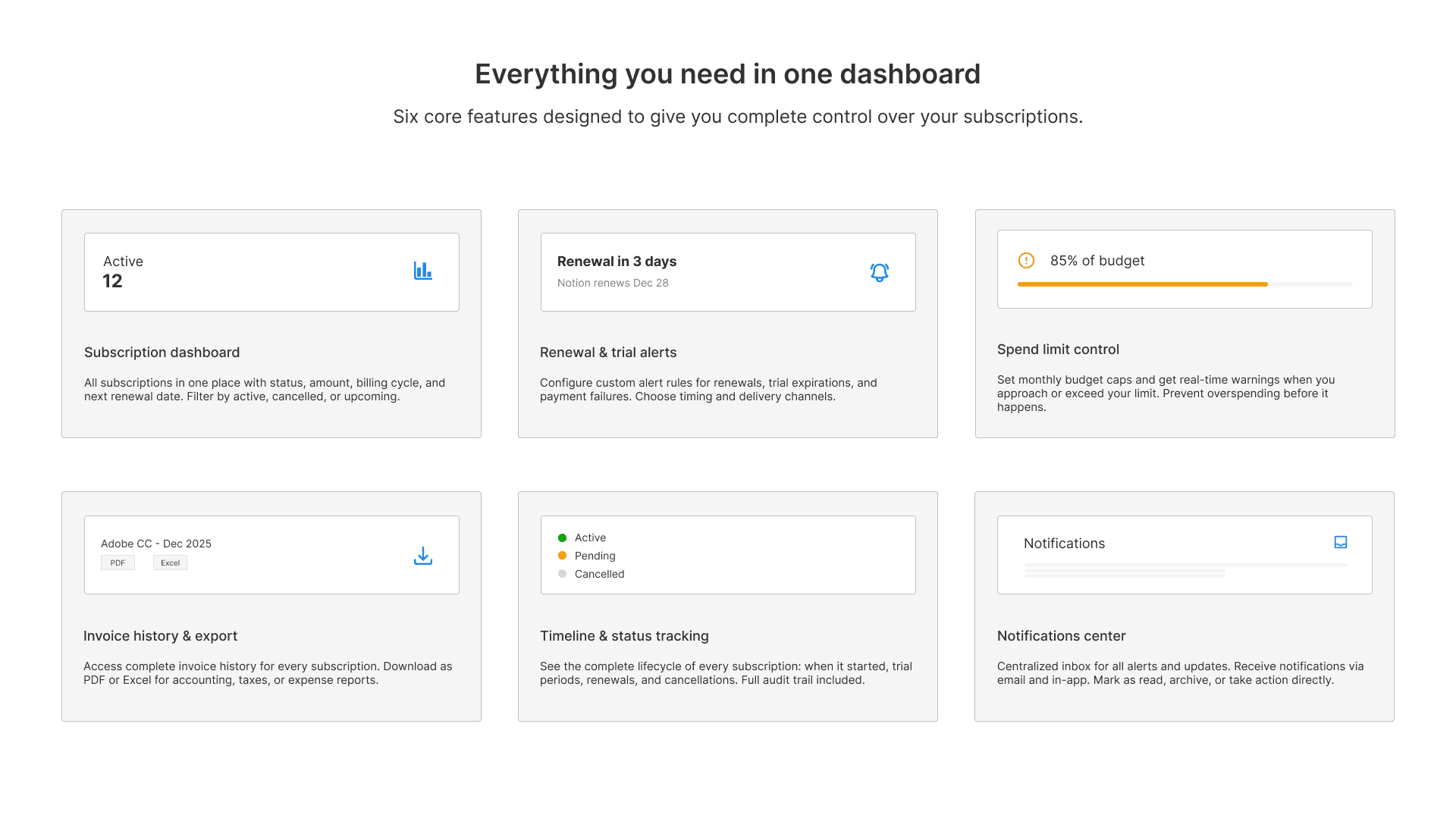
The main component of our tool is the dashboard on the homepage, where users can track subscriptions and access all relevant information in one place. This section was designed to showcase all the elements of the dashboard, highlighting how comprehensive and informative it is for users.


This section, common to most SaaS tools, was designed to clearly present our subscription pricing plans, making it easy for users to understand the options available.

Even though we offered a demo trial, we wanted to clearly show how the product works, from signing up to actively using it. We wanted to show a walkthrough video that demonstrates the complete flow and overall experience. This section was designed to help users understand what to expect, while building trust through transparency. It reassures users that the platform is safe, reliable, and capable of solving their existing manual subscription management challenges.


The Sign In and Sign Up screens for V2 were redesigned to ask only the essential information, while adopting a modern and clean look for a simpler, more user-friendly experience.
In V1, the dashboard displayed payment details and the status of payment platform connections. In V2, this was replaced with key KPI information, such as upcoming renewals, ending free trials, total monthly subscription spending, and the total number of subscriptions. These metrics are more relevant and valuable to users, while payment details are less critical to feature prominently on the dashboard.
The Alerts Settings page in V2 was redesigned to be simple and modern. All alert options were made visually clear with intuitive icons and organized for quick, easy access.
In V1, invoice history was part of the History page, while Invoice Settings had a separate page. In V2, I redesigned it so both invoice history and settings are combined on a single dedicated page, making all invoice-related information easy to access and well-organized in one place.
Final Project
From user conversations, I learned how difficult manual subscription tracking can be. The Subt prototype was designed to address these pain points by automating the entire subscription management workflow. This product is primarily aimed at small and medium-sized businesses, helping them save time. Now I have ready working prototype.
